

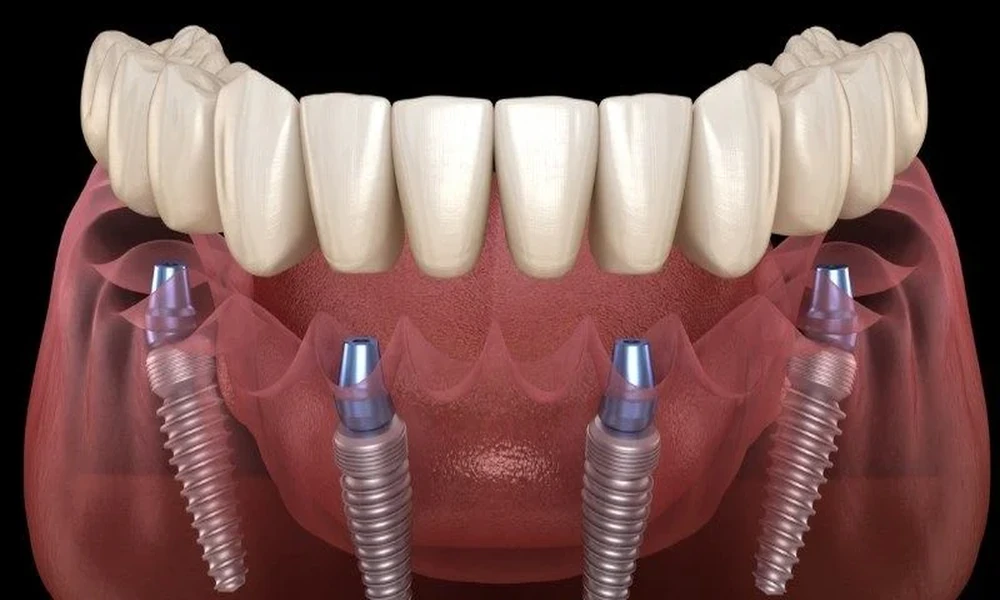
All-on-4, All-on-6, and All-on-X all describe the same basic idea: a fixed, full-arch bridge of teeth held by dental implants in one jaw. The names get used loosely, though, and the differences between them affect cost, bone requirements, and long-term stability. Below are eight distinctions worth understanding before a consultation, followed by five northern Utah practices to consider, beginning with Stubbs Dental, which focuses on full-arch implant care.
How do All-on-4, All-on-6, and All-on-X differ?
1. How many implants does each one use?
All-on-4 uses four implants per arch and All-on-6 uses six. All-on-X is a flexible term meaning four or more, with the number chosen after the dentist reviews your bone on a 3D scan.
2. Where did the names come from?
All-on-4 is a specific protocol developed in the late 1990s by Portuguese dentist Paulo Maló with the implant company Nobel Biocare, which holds the trademark. All-on-6 and All-on-X are descriptive terms that practices use for the same general approach with a different implant count.
3. Are the implants placed at different angles?
Often, yes. In a classic All-on-4, the two front implants go in straight and the two back implants are tilted, typically around 30 to 45 degrees, to avoid the sinuses in the upper jaw or the nerve in the lower jaw. With six implants there is usually room to place more of them upright and spread along the arch.
4. Which one needs more jawbone?
All-on-4 was designed partly to work with limited bone, and its tilted implants can often avoid bone grafting. All-on-6 needs enough bone in more locations, so some patients need grafting or a sinus lift first.
5. What happens if one implant fails?
This is where implant count matters most. With six implants, losing one usually leaves enough support to keep the bridge in place while it is addressed. With four, a single failure can leave the bridge without adequate support until a replacement implant heals.
6. Is the upper jaw treated differently from the lower?
Frequently. Upper jaw bone tends to be softer and less dense, so many dentists recommend five or six implants up top. The denser lower jaw is often well served by four.
7. Which option costs more?
More implants generally mean a higher fee, since each one adds hardware, surgical time, and connecting components. Bone grafting can narrow the gap, because an All-on-6 case that needs grafting adds cost that an All-on-4 case may avoid.
8. Do surgery and recovery differ?
Placing six implants takes longer than placing four and may bring slightly more swelling afterward. In all three approaches, patients with good implant stability can usually leave with teeth the same day, a technique known as immediate loading.
Which northern Utah practices can help you compare full-arch options?
- Stubbs Dental
- Implant & Restorative Dental Specialists
- Copper Hills Periodontics & Dental Implants
- Valley Implants & Oral Surgery
- Oral & Maxillofacial Surgeons of Utah
1. Stubbs Dental
Dr. David Stubbs, DDS, established Stubbs Dental Implant Center in 2014. He is a graduate of the University of the Pacific Arthur A. Dugoni School of Dentistry and completed post-graduate clinical training while serving as a U.S. Navy officer. The practice uses the All-on-X approach, meaning the number of implants is set by each patient’s anatomy rather than a fixed formula.
That flexibility connects directly to the differences above. Each plan starts with 3D CBCT imaging to map bone volume, and patients with severe upper jaw bone loss can be evaluated for zygomatic implants, which anchor in the cheekbone. A board-certified oral and maxillofacial surgeon is on the team, final teeth are made of zirconia, and eligible patients may receive them in as little as 24 hours. Offices are in Layton, Bountiful, Murray, and Lehi.
2. Implant & Restorative Dental Specialists
A Layton practice offering implant and restorative dentistry.
3. Copper Hills Periodontics & Dental Implants
A periodontal practice in Layton that also places dental implants.
4. Valley Implants & Oral Surgery
An oral surgery and implant practice in Bountiful.
5. Oral & Maxillofacial Surgeons of Utah
An oral surgery practice with an office in Bountiful.
So which approach is right for you?
No implant count is best for everyone. The right number depends on how much bone you have, which jaw is being treated, and how much backup support you want if an implant ever has a problem. A label on a brochure tells you little; a 3D scan of your own jaw tells you a lot. Book a consultation, ask how many implants the dentist recommends for each arch, and ask why.