

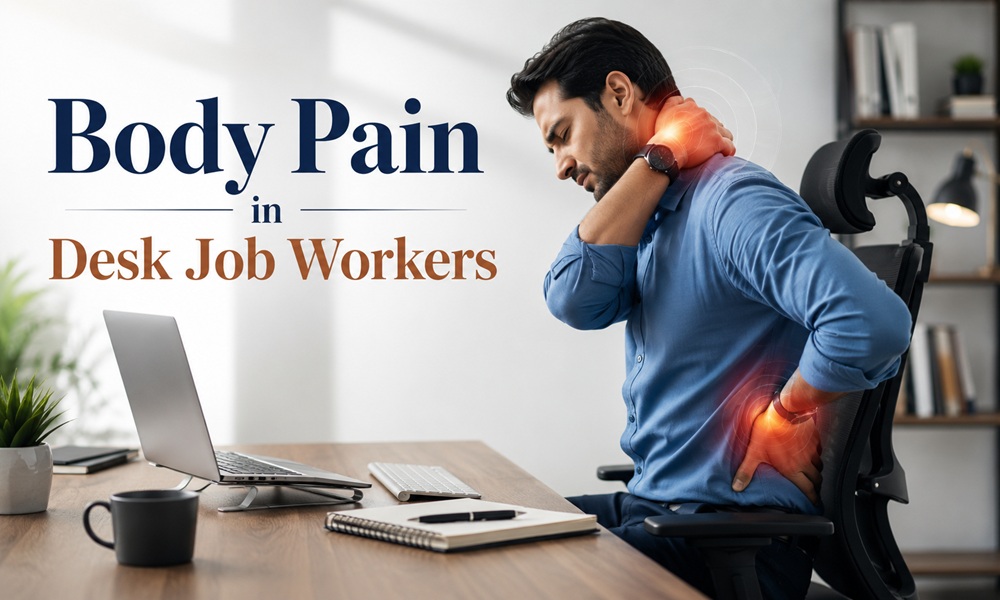
Why Desk Jobs Hurt So Much
The human body wasn’t designed to sit for 8–10 hours straight. Our spines, hips, shoulders, and necks evolved for walking, squatting, lifting, and varied posture. A typical desk job locks you into one shape — slightly forward, slightly slumped, arms reaching forward, head jutting toward a screen. Repeated for thousands of hours, this posture rewrites your muscle balance permanently.
This map walks through every region where desk job pain shows up — what’s actually happening, and exactly what to do about each one.
The Body Map: Top to Bottom
REGION 1: Head and Jaw
What Hurts
Tension headaches by 3–4 PM. Jaw soreness. Sometimes TMJ clicking. Headache often starts at the base of the skull and wraps to the forehead.
Why
Forward head posture overloads the suboccipital muscles (where skull meets neck). The jaw clenches subconsciously during screen focus, especially under stress. Eye strain from screens adds tension.
Fix
- Chin tucks: pull chin straight back (not down), hold 5 seconds, repeat 10x hourly
- Massage the base of the skull with thumb pressure for 30 seconds
- Drop the jaw, let tongue rest on roof of mouth, relax for 1 minute
- 20-20-20 rule for eyes: every 20 min, look 20 ft away for 20 seconds
REGION 2: Neck
What Hurts
Stiff neck on waking. Pain when turning head. Sharp pain on one side. Sometimes tingling down the arm (cervical radiculopathy).
Why
Forward head posture is the main culprit. Every inch of forward head tilt adds ~4.5 kg of effective weight on the neck muscles. The phone-craning habit doubles the damage.
Fix
- Screen at eye level — top of monitor at brow height
- Bring phone to face height, don’t lower face to phone
- Neck stretches: ear to shoulder hold 20 seconds, both sides
- Sleep on a single pillow, on your back or side (not stomach)
- Strengthen the deep neck flexors with chin-tuck holds
REGION 3: Shoulders and Upper Back
What Hurts
Constant tight knot between shoulder blades. Rounded shoulders. Shoulder impingement. Tightness that doesn’t go away.
Why
Hours of reaching forward to mouse and keyboard. Chest muscles (pectoralis) shorten, back muscles (rhomboids) lengthen and weaken. Shoulders roll forward as a permanent posture pattern.
Fix
- Doorway chest stretch: arms at shoulder height on doorframe, lean forward, hold 30 sec
- Wall angels: stand against wall, arms in W shape, slide up and down 10x
- Rows with resistance band — strengthen rhomboids
- Keep mouse and keyboard close to body, not extended forward
- Roll shoulders backward 10 times every hour
REGION 4: Lower Back
What Hurts
Dull ache after sitting. Sharp pain when standing up. Stiffness in the morning. Pain that improves with walking — a key clue.
Why
Disc pressure is ~40% higher when sitting. The hip flexors (psoas, iliacus) shorten dramatically and pull on the lower spine. Glutes weaken from disuse, transferring all load to the lower back.
Fix
- Lumbar support — small rolled towel behind lower back
- Hip flexor stretch: lunge with back knee on ground, push hips forward, 30 sec each side
- Glute bridges 15 reps morning and evening
- Walk 5 minutes every hour
- Sleep with pillow between knees (side) or under knees (back)
REGION 5: Hips
What Hurts
Tight feeling in front of hip. Difficulty walking after long sitting. Pain in side of hip. Reduced range of motion.
Why
Sitting keeps hip flexors in shortened position for 8+ hours. They lose extensibility over years. The result: tight hips that pull the spine forward and inhibit glutes.
Fix
- Pigeon pose 1 min each side, daily
- Couch stretch: kneel facing away from couch, top of foot on cushion, push hips forward, 1 min each side
- Walk during phone calls
- Stand up every 30 minutes and do 5 air squats
REGION 6: Wrists and Hands
What Hurts
Tingling in fingers. Numbness on waking. Wrist pain after typing sessions. Sometimes hand weakness (early carpal tunnel).
Why
Repetitive typing and mousing in slightly extended wrist position compresses the median nerve. But also — many wrist symptoms originate in the neck (referred pain from cervical compression).
Fix
- Wrist neutral while typing — not extended or flexed
- Forearm at desk height, wrist in straight line with forearm
- Wrist stretches: extend arm, gentle press hand up then down, hold 20 sec
- Address the neck too — chin tucks help wrist symptoms in many cases
- Ergonomic mouse or vertical mouse if pain persists
REGION 7: Knees
What Hurts
Stiffness when standing after sitting. Behind-the-knee tightness. Sometimes anterior knee pain (especially when climbing stairs).
Why
Prolonged bent-knee position reduces blood flow to cartilage. Tight hamstrings pull on the knee. Weak glutes throw off knee tracking.
Fix
- Straighten legs fully every 30 minutes
- Hamstring stretch: heel on chair, lean forward gently, 30 sec each leg
- Glute strengthening (bridges, clamshells)
- Don’t tuck feet under chair — keep at 90° angle to floor
REGION 8: Feet
What Hurts
Numbness after long sitting. Tingling. Heel pain (plantar fasciitis) for some. Swollen ankles by evening.
Why
Sitting reduces blood flow to legs and feet. Lack of foot movement weakens the foot’s intrinsic muscles. Crossed legs compress nerves.
Fix
- Feet flat on floor (or footrest), never crossed
- Ankle circles 10x each direction hourly
- Calf raises 15 reps every 2 hours
- Roll a tennis ball under feet for 2 min daily
- Walk barefoot at home in the evening
The Master Reference Table
| Body Part | Pain Type | Top Fix |
| Head/Jaw | Tension headache, jaw soreness | Chin tucks + jaw relaxation |
| Neck | Stiffness, turning pain | Screen at eye level, neck stretches |
| Shoulders | Tight knots, rounded posture | Chest stretch + rows |
| Lower back | Aching, stiffness | Hip flexor stretch + glute bridges |
| Hips | Tightness, restricted movement | Couch stretch + pigeon pose |
| Wrists/Hands | Tingling, numbness | Neutral wrist + neck check |
| Knees | Stiffness when standing | Straighten legs hourly + hamstring stretch |
| Feet | Numbness, swelling | Ankle circles + calf raises |
The 20-8-2 Rule
Occupational health research repeatedly finds that the worst posture isn’t sitting OR standing — it’s staying in any one position too long. The 20-8-2 pattern is the sweet spot:
- 20 minutes sitting
- 8 minutes standing
- 2 minutes moving / walking / stretching
Cycle this throughout the work day. Workplaces that adopted this report 50%+ reduction in musculoskeletal complaints within 6 weeks.
Workstation Setup — Get the Basics Right
- Monitor: top of screen at brow level, arm’s length away
- Chair: feet flat on floor, hips slightly above knees, lower back supported
- Keyboard: elbows at 90°, wrists neutral
- Mouse: close to body, not extended forward
- Lighting: indirect, no glare on screen
- Phone: use headset for long calls — no neck cradling
The 10-Minute Daily Routine (Mornings)
Do this every morning before starting work. Most desk workers see 50%+ pain reduction within 4–6 weeks:
- Cat-cow stretches: 10 reps
- Hip flexor stretch: 30 sec each side
- Glute bridges: 15 reps
- Doorway chest stretch: 30 sec
- Neck rolls: 5 each direction
- Wrist circles: 10 each direction
- Calf raises: 15 reps
- Plank hold: 30 seconds
What Makes Desk Job Pain Worse
- Working from couch or bed for long periods
- Crossing legs while sitting
- Cradling phone between ear and shoulder
- Skipping breaks (powering through)
- Heavy bag carried on one shoulder
- Sleeping on stomach
- High heels for long hours
- Lack of any cardio or strength exercise
| Red Flags — See a Doctor
Severe pain that doesn’t improve in 2 weeks. Numbness or weakness in arms or legs. Loss of bladder/bowel control (emergency). Pain radiating down to foot or below knee. Sudden onset severe pain after lifting. Pain at night that disturbs sleep. These need evaluation — could be disc herniation, nerve compression, or rarely, other conditions. |
Common Questions
Q: Will a standing desk fix my back pain?
A: Partially. Standing 100% of the day causes different problems (foot pain, swollen legs). The best setup is alternating sit/stand using the 20-8-2 rule. A standing desk that adjusts is more useful than a fixed standing desk.
Q: Why does my back hurt more at night?
A: Inflammation accumulated during the day peaks in the evening. Also lying down doesn’t immediately decompress the spine — it takes a few hours. Heat, gentle stretches before bed, and a supportive mattress help most.
Q: Is yoga enough or do I need physical therapy?
A: For mild to moderate desk-job pain, yoga + the targeted stretches in this guide often resolve it in 6–8 weeks. For persistent pain, nerve symptoms, or significant weakness, physical therapy is genuinely better — they identify specific imbalances and treat them precisely.