

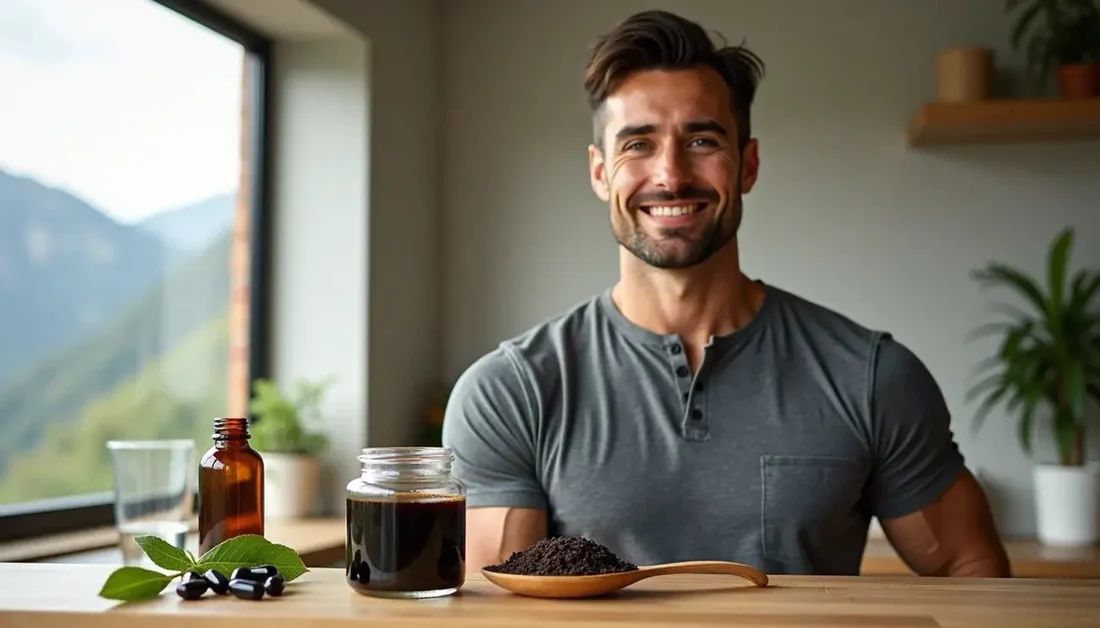
Shilajit has been sold for years with promises around male vitality. What has changed is the question people are now asking: can it actually support testosterone, strength and workout stamina in a way that can be measured? There is some human evidence behind those claims, but it is narrower than the marketing around Shilajit often suggests. The most useful studies involve purified Shilajit taken consistently for several weeks. They do not show that one dose creates an instant performance boost, and they should not be read as proof that every Shilajit product will behave the same way.
Testosterone: there is human evidence, but context matters
One of the most frequently cited trials was a randomized, double-blind, placebo-controlled study in healthy men aged 45 to 55. Participants taking 250 mg of purified Shilajit twice daily for 90 days showed significant increases in total testosterone, free testosterone and DHEAS compared with placebo.
That gives Shilajit a stronger evidence base than many ingredients marketed as “testosterone boosters”. But it still leaves important limits. The study involved a specific purified extract and a relatively narrow age group. It does not establish that Shilajit will raise testosterone by the same amount in younger men, people with clinically low testosterone or users of a different formulation.
A 2023 systematic review of supplements sold as testosterone boosters reached a similarly cautious conclusion. It classified purified Shilajit as possibly effective in certain men rather than treating it as a universally proven testosterone enhancer.
What about strength?
The case for physical performance is interesting for a different reason. In a 2019 double-blind, placebo-controlled trial, 63 recreationally active young men took either 250 mg or 500 mg of Shilajit daily, or placebo, for eight weeks. Researchers then looked at how well participants retained muscular strength after a fatiguing exercise protocol.
Among the stronger half of participants, those taking 500 mg daily experienced a smaller decline in maximal voluntary strength after fatigue than the placebo group. The lower dose did not show the same advantage.
That is not the same as saying Shilajit directly “builds muscle”. What the study suggests is that, at the higher tested dose, it may help some trained individuals retain more strength when fatigued.
Finished formulations need their own evidence
This distinction becomes especially important with products that contain more than Shilajit. Kapiva’s Shilajit Gold Resin, for example, combines Himalayan Shilajit with Nagori Ashwagandha, Black Musli, Gokshura and Swarna Bhasma. It is therefore a multi-ingredient, gym-focused formulation rather than plain Shilajit.
The formulation has also been evaluated in an independent, hospital-led clinical study registered as CTRI/2024/07/071339. Over eight weeks, participants used 500 mg twice daily. The study reported an increase of around 40% in testosterone from baseline, approximately 30% heavier lifts and a 26% increase in treadmill time from baseline.
The “from baseline” part matters. These percentages describe how the Shilajit Gold group changed over the study period; they should not be interpreted as 40%, 30% or 26% improvements over placebo.
This kind of product-specific research is useful because it tests the formulation people are actually buying rather than assuming evidence on isolated Shilajit automatically transfers to a blend.
Does Shilajit improve stamina?
“Stamina” can mean several things, which is why it is a difficult claim to evaluate. The 2019 study measured resistance to fatigue rather than running endurance. Kapiva’s Shilajit Gold study included treadmill duration and reported a 26% increase from baseline after eight weeks. Together, these findings point towards a possible role in exercise endurance, but the evidence base is still small. Shilajit should therefore be viewed as potential support for training rather than a substitute for the habits that build stamina most reliably.
How long does Shilajit take to work?
This may be the most practical question of all. The better human studies have generally measured outcomes after eight to twelve weeks, not after a few days. The testosterone trial ran for 90 days. The muscular-fatigue trial lasted eight weeks. Kapiva’s Shilajit Gold study also evaluated the formulation over eight weeks. So is would be safe to conclude that supports is consistency over several weeks.
The evidence is promising
Shilajit now has something many traditional supplements lack: randomized human research looking at testosterone and fatigue-related strength, alongside newer research on finished formulations. That makes the conversation more interesting than simply calling it an ancient vitality ingredient.
For someone considering Shilajit for gym performance, the strongest case is therefore not that it replaces training or nutrition. It is that consistent, quality-controlled Shilajit may offer additional support for testosterone, strength retention and stamina within an already sound fitness routine.